17 Online Business Mistakes Beginners Make (And How to Avoid Them)
Starting an online business feels like navigating a minefield blindfolded.
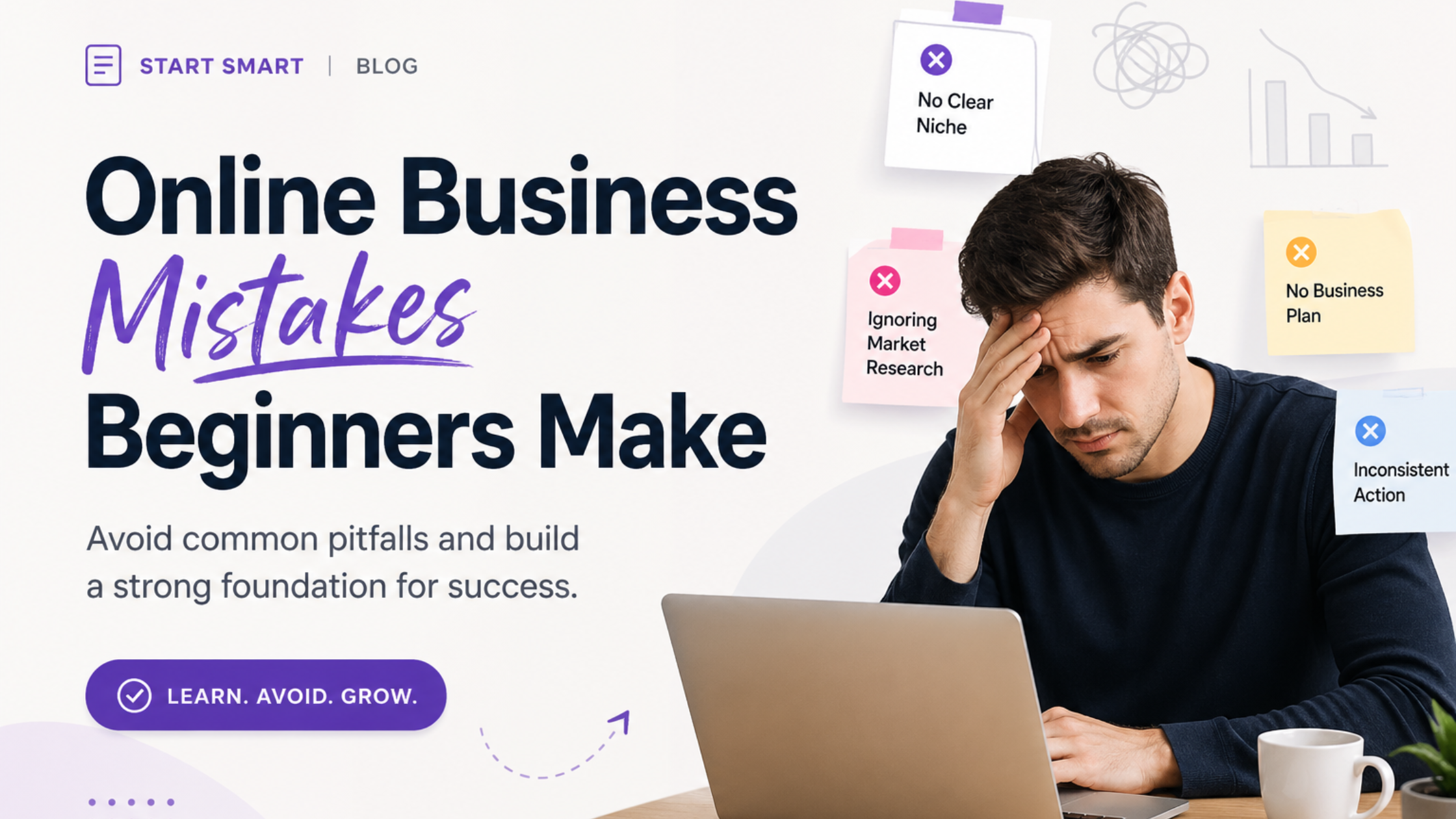
Visual Summary
Swipe through the key slides
17 traps that kill new online businesses — and how to escape them
Use Shift + mouse wheel or swipe horizontally to move through the visual companion deck.
Introduction
Starting an online business feels like navigating a minefield blindfolded.
Every day brings new decisions, new tools to learn, and new "experts" telling you different strategies. It's overwhelming, and it's easy to make mistakes that cost you months of progress and thousands of dollars.
The good news: Almost every beginner makes the same mistakes. Which means you can avoid most of them simply by learning what they are.
This guide reveals the 17 most common (and most costly) mistakes new online entrepreneurs make, why they happen, and exactly how to avoid them. Consider it your early warning system for the entrepreneurial journey ahead.
The 5 Categories of Beginner Business Mistakes
Strategy Mistakes: Wrong Direction from the Start
These mistakes affect your fundamental business approach and can waste months or years heading in the wrong direction.
Execution Mistakes: Good Ideas, Poor Implementation
You know what to do but execute it poorly, leading to disappointing results despite solid strategy.
Mindset Mistakes: Mental Barriers to Success
These mistakes come from limiting beliefs, unrealistic expectations, or poor decision-making frameworks.
Resource Mistakes: Wasting Time and Money
Poor allocation of your most precious resources — time, money, and attention.
Marketing Mistakes: Building Something Nobody Finds
Great product, terrible marketing leads to the "build it and they will come" fantasy.
Strategy Mistakes
Mistake #1: Trying to Help Everyone
What it looks like: "I help small businesses with their marketing and operations and strategy and websites..."
Why beginners do this: Fear of missing out on potential customers by being too specific
The real cost:
-
Marketing becomes generic and ineffective
-
Can't become expert at anything
-
Customers don't know what you actually do
-
Pricing becomes race to bottom
How to avoid it:
-
Choose ONE specific problem for ONE specific type of customer
-
You can expand later after dominating your niche
-
Example: Instead of "marketing for small businesses," choose "Facebook ads for dental practices"
Real example: Jennifer started as a "general marketing consultant" and struggled to get clients at good rates. She focused on email marketing for real estate agents and tripled her rates within 6 months.
Mistake #2: Building Without Validating
What it looks like: Spending months creating a product before talking to potential customers
Why beginners do this: Afraid to share "imperfect" ideas, assume they know what customers want
The real cost:
-
Building products nobody wants
-
Months of wasted development time
-
Financial investment in wrong direction
-
Crushing disappointment when launch fails
How to avoid it:
-
Talk to 20+ potential customers before building anything
-
Validate the problem first, then validate your solution
-
Start with pre-sales or simple MVP testing
-
Build only after confirming demand
Real example: Mark spent 8 months building a complex project management tool for freelancers. After launch, discovered most freelancers were happy with simple tools like Trello. Could have learned this with 2 weeks of customer interviews.
Mistake #3: Copying Instead of Differentiating
What it looks like: Building exactly what successful competitors offer but slightly cheaper
Why beginners do this: Thinking successful markets mean easy money, afraid to be different
The real cost:
-
Competing on price only
-
No unique value proposition
-
Difficult customer acquisition
-
Unsustainable business model
How to avoid it:
-
Study what competitors do poorly (read their negative reviews)
-
Find underserved segments or unmet needs
-
Be 10x better at ONE specific thing
-
Create unique positioning, not copycat products
Execution Mistakes
Mistake #4: Perfectionism Paralysis
What it looks like: Spending months perfecting website, logo, or product before launching
Why beginners do this: Want everything perfect, afraid of judgment, think perfection prevents failure
The real cost:
-
Delayed launch means delayed learning
-
Perfect products often miss market needs
-
Opportunity cost of time spent polishing
-
Analysis paralysis prevents progress
How to avoid it:
-
Set "good enough" standards for launch
-
Plan to improve based on customer feedback
-
Launch with 80% ready rather than 100% perfect
-
Remember: feedback beats guessing every time
Real example: Lisa spent 6 months perfecting her course website design. When she finally launched, discovered customers cared more about course content quality than website beauty. Could have launched in month 1 and improved based on real feedback.
Mistake #5: Feature Creep Before Product-Market Fit
What it looks like: Continuously adding features without validating core value proposition
Why beginners do this: Think more features = more value, easier than fixing fundamental problems
The real cost:
-
Increased complexity confuses customers
-
Dilutes focus from core value proposition
-
Development resources wasted on unnecessary features
-
Delays finding product-market fit
How to avoid it:
-
Validate core functionality first
-
Add features only based on customer requests
-
Focus on doing ONE thing exceptionally well
-
Measure usage before adding complexity
Mistake #6: Underpricing to "Get Started"
What it looks like: Charging significantly below market rates because "I'm just starting out"
Why beginners do this: Lack confidence in value provided, afraid no one will pay fair prices
The real cost:
-
Attracts wrong type of customers
-
Creates unsustainable business model
-
Difficulty raising prices later
-
Undervalues your expertise and time
How to avoid it:
-
Research market rates for your services
-
Price within 20% of average, not 50% below
-
Lead with value, not price
-
Remember: cheap customers are often most difficult
Real example: Tom started freelance writing at $10/hour because he was "new." Attracted difficult clients who demanded rewrites. When he raised prices to $50/hour, found better clients who valued his work and gave clearer direction.
Mindset Mistakes
Mistake #7: Expecting Overnight Success
What it looks like: Planning to quit job in 3 months, expecting immediate profitability
Why beginners do this: Influenced by social media success stories, underestimate time required for business building
The real cost:
-
Premature quitting leads to financial stress
-
Poor decision-making under pressure
-
Giving up before reaching success
-
Inadequate planning for business timeline
How to avoid it:
-
Plan for 12-18 month timeline to meaningful income
-
Keep income sources during early business building
-
Set realistic monthly milestones
-
Focus on learning and building, not just earning
Mistake #8: Comparing Your Beginning to Others' Highlight Reels
What it looks like: Getting discouraged by others' success stories and feeling behind
Why beginners do this: Social media shows only successes, not struggles or timeline
The real cost:
-
Discouragement leads to quitting
-
Poor decision-making based on incomplete information
-
Imposter syndrome and self-doubt
-
Copying others' strategies without understanding context
How to avoid it:
-
Focus on your own progress and timeline
-
Remember most success stories omit years of preparation
-
Find mentors who share realistic journeys
-
Measure progress against your past self, not others
Mistake #9: Giving Up Too Early
What it looks like: Quitting after 3-6 months because results aren't meeting expectations
Why beginners do this: Unrealistic timeline expectations, lack of understanding of normal business growth
The real cost:
-
Missing breakthrough that was 3 months away
-
Wasted investment in business setup and learning
-
Pattern of quitting prevents long-term success
-
Never developing expertise or reputation
How to avoid it:
-
Commit to 12 months minimum before evaluating
-
Set learning goals, not just income goals
-
Track leading indicators (skills, customers, systems) not just revenue
-
Have realistic expectations about business building timeline
Resource Mistakes
Mistake #10: Spending Money Instead of Time
What it looks like: Buying courses, tools, and services instead of doing foundational work
Why beginners do this: Think money can accelerate results, avoid difficult learning
The real cost:
-
Financial pressure without proportional results
-
Dependency on external solutions
-
Missed learning opportunities
-
Unsustainable business model
How to avoid it:
-
Invest time in learning before spending money on tools
-
Start with free/cheap alternatives
-
Buy tools only after manual processes prove necessary
-
Invest in skills development over shortcuts
Mistake #11: Trying to Do Everything Yourself
What it looks like: Learning graphic design, web development, copywriting, and marketing simultaneously
Why beginners do this: Want to save money, think they need to master everything
The real cost:
-
Mediocre results in all areas
-
Overwhelm and burnout
-
Slower progress than focusing
-
Missing opportunities while learning non-essential skills
How to avoid it:
-
Focus on core competencies first
-
Outsource or use tools for non-essential skills
-
Learn business-critical skills first (sales, marketing, core service)
-
Get help in areas outside your strengths
Mistake #12: Not Tracking Money Properly
What it looks like: Mixing business and personal expenses, no clear profit/loss tracking
Why beginners do this: Focus on revenue not profit, accounting seems complicated
The real cost:
-
No understanding of true profitability
-
Tax complications and missed deductions
-
Poor decision-making without financial data
-
Difficulty scaling without clear unit economics
How to avoid it:
-
Set up separate business accounts from day one
-
Track all income and expenses monthly
-
Use simple accounting software (QuickBooks, Wave)
-
Monitor key metrics: profit margin, customer acquisition cost, lifetime value
Ready to Apply What You've Learned?
Stop reading theory. StartOva builds the actual website, code, and deployment so you can focus on growing your business.
Marketing Mistakes
Mistake #13: Build It and They Will Come
What it looks like: Creating great product but doing no marketing, expecting customers to find it naturally
Why beginners do this: Overestimate product's inherent appeal, underestimate marketing importance
The real cost:
-
Great products fail due to lack of visibility
-
Wasted development effort
-
Missed revenue opportunities
-
Business failure despite good product
How to avoid it:
-
Start marketing before you finish building
-
Spend 50% of time on marketing, 50% on product development
-
Build audience while developing product
-
Test marketing messages during development phase
Mistake #14: Trying Every Marketing Channel
What it looks like: Being on Instagram, Twitter, LinkedIn, TikTok, YouTube, blogging, and email marketing simultaneously
Why beginners do this: Fear of missing out, think more channels = more customers
The real cost:
-
Mediocre presence on all channels
-
Overwhelm and inconsistent messaging
-
Unable to measure what works
-
Spreading limited time too thin
How to avoid it:
-
Choose 1-2 marketing channels maximum
-
Master those channels before adding others
-
Focus on where your customers actually spend time
-
Measure results and double down on what works
Mistake #15: No Email List Building
What it looks like: Driving traffic to social media or website without capturing email addresses
Why beginners do this: Don't understand email marketing value, focus on vanity metrics like followers
The real cost:
-
No direct customer communication channel
-
Dependent on platform algorithms
-
Missed revenue from repeat customers
-
Difficulty launching new products/services
How to avoid it:
-
Start email list from day one
-
Offer valuable lead magnets to encourage signups
-
Email consistently (weekly minimum)
-
Treat email list as your most valuable business asset
Mistake #16: Weak or Missing Value Proposition
What it looks like: Can't clearly explain what you do and why someone should choose you in 30 seconds
Why beginners do this: Too close to their own business, assume others understand the value
The real cost:
-
Confusing marketing messages
-
Low conversion rates
-
Difficulty differentiating from competitors
-
Poor word-of-mouth referrals
How to avoid it:
-
Test your elevator pitch with strangers
-
Focus on customer outcomes, not features
-
Be specific about who you help and how
-
Get feedback from current customers about your value
Mistake #17: Not Understanding Your Customers
What it looks like: Making assumptions about customer needs, preferences, and decision-making
Why beginners do this: Lack customer research, assume customers think like they do
The real cost:
-
Products that miss customer needs
-
Ineffective marketing messages
-
Poor customer experience
-
Low customer satisfaction and retention
How to avoid it:
-
Talk to customers regularly (monthly minimum)
-
Survey customers about their needs and preferences
-
Study customer behavior and feedback
-
Test assumptions with real customer data
How to Avoid These Mistakes: Your Prevention Strategy
Before You Start
-
Choose specific niche and validate demand (avoids mistakes #1, #2)
-
Research competition and find differentiation (avoids mistake #3)
-
Set realistic timeline expectations (avoids mistakes #7, #9)
-
Plan marketing strategy before building (avoids mistake #13)
In Your First 3 Months
-
Launch "good enough" version quickly (avoids mistake #4)
-
Price fairly from start (avoids mistake #6)
-
Focus on ONE marketing channel (avoids mistake #14)
-
Start email list immediately (avoids mistake #15)
Ongoing Prevention
-
Track finances monthly (avoids mistake #12)
-
Talk to customers regularly (avoids mistake #17)
-
Measure progress realistically (avoids mistake #8)
-
Focus on core competencies (avoids mistake #11)
The Cost of These Mistakes
Time Costs
-
Average delay: 6-18 months additional time to profitability
-
Wasted effort: 40-60% of initial work often needs to be redone
-
Learning curve: 3-6 months to recover from major strategic mistakes
Financial Costs
-
Direct costs: $2,000-$10,000 in wasted tools, courses, and services
-
Opportunity costs: $10,000-$50,000 in lost income during delay period
-
Emotional costs: Stress, discouragement, and relationship strain
Success Rate Impact
-
Businesses that avoid these mistakes: 60-70% success rate
-
Businesses that make multiple mistakes: 10-20% success rate
Your Mistake Prevention Checklist
Strategy Prevention
-
Chosen specific niche and target customer
-
Validated problem and solution with 20+ potential customers
-
Identified clear differentiation from competitors
-
Created compelling value proposition
Execution Prevention
-
Set launch deadline and "good enough" standards
-
Researched and set fair pricing
-
Limited initial feature set to core functionality
-
Planned marketing strategy before building
Mindset Prevention
-
Set realistic 12-18 month timeline expectations
-
Identified learning goals alongside income goals
-
Committed to minimum 12 months before major pivots
-
Found realistic mentors and success stories
Resource Prevention
-
Created separate business finances tracking
-
Prioritized time investment over tool purchases
-
Identified core competencies to focus on
-
Planned when to outsource vs do yourself
Marketing Prevention
-
Chosen 1-2 primary marketing channels
-
Set up email capture from day one
-
Planned to spend 50% time on marketing
-
Scheduled regular customer feedback sessions
Conclusion
Key Insights
-
Most beginner mistakes are predictable and preventable
-
Strategic mistakes (niche, validation, differentiation) are most costly
-
Perfectionism delays learning more than poor launches
-
Realistic expectations prevent premature quitting
-
Marketing is as important as product development
-
Customer feedback prevents assumption-based mistakes
-
Financial tracking and realistic pricing are essential from day one
Every successful entrepreneur has made most of these mistakes. The difference between success and failure isn't perfection — it's how quickly you recognize and correct mistakes.
Use this guide as your early warning system. When you catch yourself making these mistakes, don't panic. Acknowledge it, course correct, and keep moving forward.
Remember: The goal isn't to avoid all mistakes (impossible), but to avoid the mistakes that kill businesses before they have a chance to succeed.
Your future self will thank you for learning these lessons before you need them instead of after you've paid the price.
Ready to start your business with fewer mistakes? Learn about how to start an online business or explore validated business ideas that reduce your risk.
This guide was created to help new entrepreneurs avoid common, costly mistakes that derail online businesses.
Continue Your Learning Path
Explore connected topics and take action
Get More Guides Like This
Join 2,000+ business owners getting actionable website ownership guides delivered weekly.
No spam. Unsubscribe anytime. We respect your privacy.
Turn Knowledge Into Action
You've learned the concepts. Now get the owned website, GitHub code, and live deployment to make it real.